
Search Connecticut Court Records
The official Connecticut Judicial Branch Case Look-up is the best starting point. It is a hub, not one database. Separate tools cover appellate matters, Superior Court civil and family cases, housing and small claims, and criminal or motor vehicle cases. Choose by case family before entering a name. A civil party search will not return a criminal docket, and the criminal search will not locate a divorce. Probate and federal cases also sit outside those Superior Court tools.
Gather the party or defendant name, an approximate filing year, the town where the matter arose, and any docket number. Connecticut assigns cases by judicial district, Geographical Area, housing session, juvenile venue, or probate district. The old county name alone may lead to the wrong counter. The location code in a result identifies the responsible courthouse. That court's Chief Clerk remains the source for certified copies, older paper files, and public documents that the web display does not include.
- Open the case hub and choose the system that matches the case family.
- Search by party name or docket number. Add the court location or case type when needed.
- Read the location code, docket number, status, and document list. Note the system's data-current notice.
- Use the directory to identify the responsible Chief Clerk, Probate Court, or municipal office.
- Ask about inspection, certification, redaction, delivery, and the current fee before ordering.
The official Superior Court civil inquiry shows how Connecticut divides civil, family, housing, and small claims access.
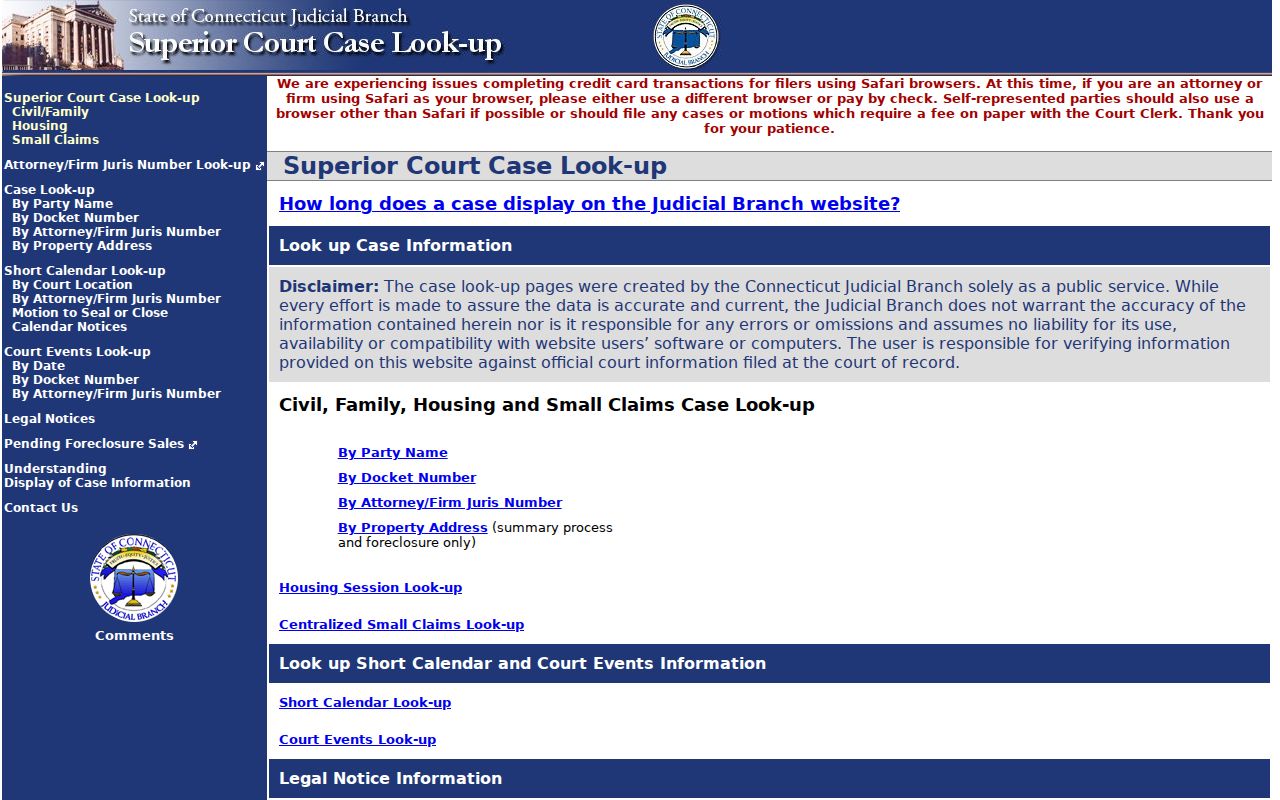
Its separate party and docket searches make the case category, location, and number just as important as the person's name.
Connecticut Court System Structure
Connecticut has a unified state court system. Superior Court is the sole trial court of general jurisdiction. Civil, criminal, family, housing, juvenile, and small claims work is assigned among judicial districts, Geographical Area courts, and special sessions. There is no operating county court tier. The Connecticut Appellate Court is one statewide intermediate court, and the Connecticut Supreme Court is the court of last resort. The full Connecticut court system page explains venue and federal routing in more depth.
Connecticut Probate Courts form a separate local-district network for estates, trusts, guardianships, conservatorships, adoptions, and other probate matters. A Probate Court decision may be appealed to Superior Court. Federal matters never enter that state path. They begin in the U.S. District Court for the District of Connecticut and move to the Second Circuit.
Typical appeals path: Superior Court or Probate appeal › Connecticut Appellate Court › Connecticut Supreme Court
| Court | Role | Organization |
|---|---|---|
| Connecticut Supreme Court | Final state review | One statewide high court |
| Connecticut Appellate Court | Intermediate review | One statewide court without regional districts |
| Superior Court | General trial jurisdiction | Thirteen judicial districts plus GA and special sessions |
| Connecticut Probate Courts | Special probate jurisdiction | Fifty-four local courts |
Connecticut Court Record Types
Superior Court civil files may contain complaints, appearances, motions, judgments, foreclosure records, contracts, tort claims, agency appeals, and small claims material. Family dockets cover dissolution, legal separation, annulment, custody, support, parentage, and protective-order cases. Criminal files track filed charges, pleas, hearings, dispositions, and sentences. A motor vehicle case may appear in the criminal and motor vehicle system, while a parking ticket can remain a municipal record. Probate files are searched through Connecticut Probate Courts unless the matter is a probate appeal.
- Criminal: pending counts, arraignment events, pleas, motions, dispositions, sentences, and public conviction data.
- Civil: claims, answers, motion practice, scheduled events, orders, and judgments.
- Family: divorce and related dockets, with sensitive financial and child information restricted.
- Probate: estates and trusts in the public lookup, plus locally held special files.
- Traffic: docketed motor vehicle cases, separate from DMV histories and city parking files.
The Connecticut Probate Case Lookup is a separate record path.
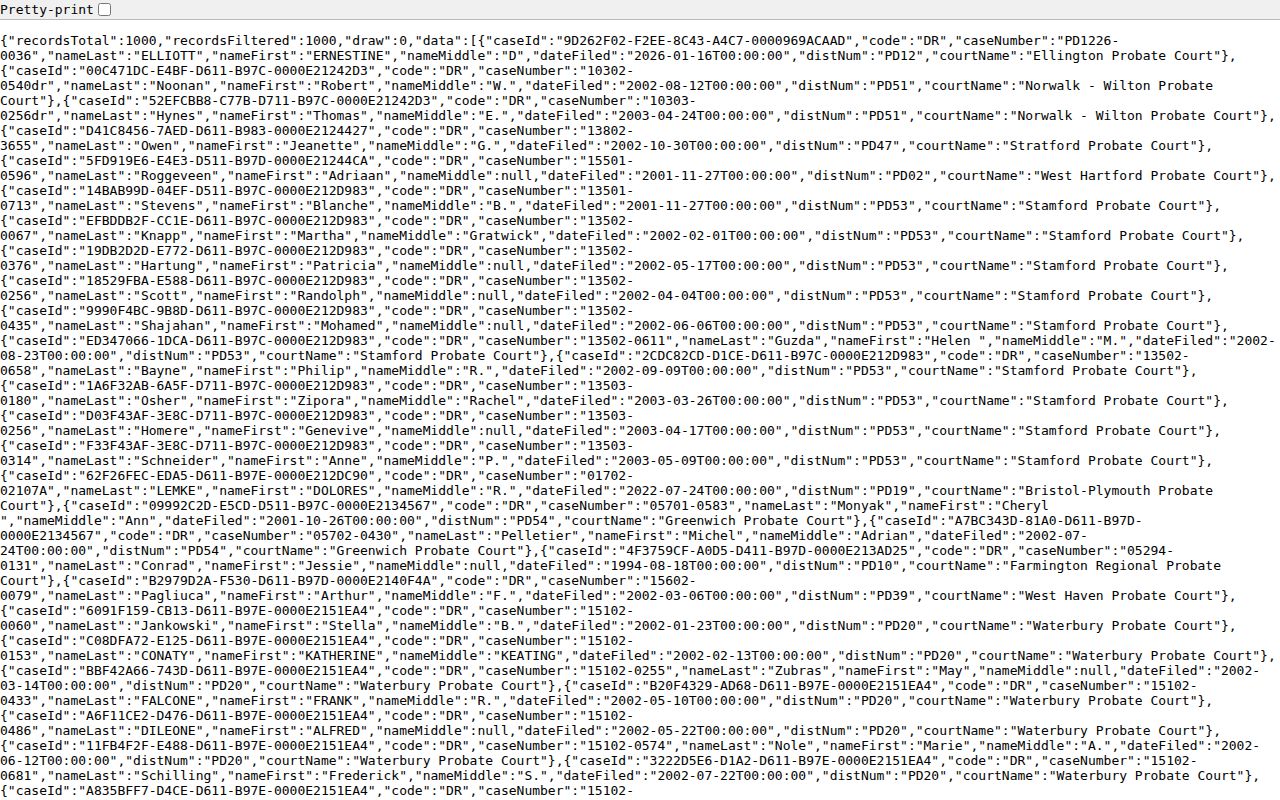
It covers decedent estates and trusts from January 5, 2011 forward, while older results are incomplete.
Read Connecticut Court Records
A docket number is the best key. Civil and family numbers combine a location code, category, year, and sequence. Criminal and motor vehicle dockets add a court code, case type, year, number, and suffix. A public record may show parties, charges or claims, filing dates, court events, motions, orders, and a disposition. A disposition is the present or final result. Read it at the count level because one criminal docket can contain several charges with different outcomes.
| Field | What It Shows |
|---|---|
| Docket Number | Location, case category, filing year, sequence, and suffix |
| Location | The assigned judicial district, GA court, or housing session |
| Parties | Public names and roles such as plaintiff, defendant, or petitioner |
| Charges or Claim | The filed criminal counts or civil cause of action |
| Disposition | The result for a case or individual count |
| Sentence or Judgment | The final criminal penalty or civil and family order |
Online results are indexes, not always the full file. An entry may show that a motion exists without offering the image. Sealed matters, personal identifiers, juvenile material, protected addresses, and some family or probate documents stay hidden. Ask the clerk for the public portion when a document list is incomplete.
Connecticut Statewide Record Systems
Court lookups answer only part of a record question. Connecticut's Department of Correction holds both pretrial and sentenced people, so its inmate system replaces the county-jail model used in many states. The Department of Motor Vehicles maintains driver histories. The Department of Public Health issues state vital records but does not keep divorce decrees. The State Police Bureau of Identification compiles criminal histories, which differ from the pleadings and orders in one Superior Court file.
Each system has its own correction and copy process. A DOC profile is not proof of conviction, a DMV history is not the traffic-court file, and an SBI report is not a certified court disposition. Start with the official system that owns the requested fact.
| System | What It Holds | Run By |
|---|---|---|
| DOC Inmate Search | Current Connecticut custody information | Department of Correction |
| Criminal History Request | Reportable arrest and disposition history | State Police Bureau of Identification |
| Driver History Request | License history and sanctions | Department of Motor Vehicles |
| State Vital Records | Certified marriage and other vital records | Department of Public Health |
The Connecticut State Vital Records Office shows the statewide certificate channel.
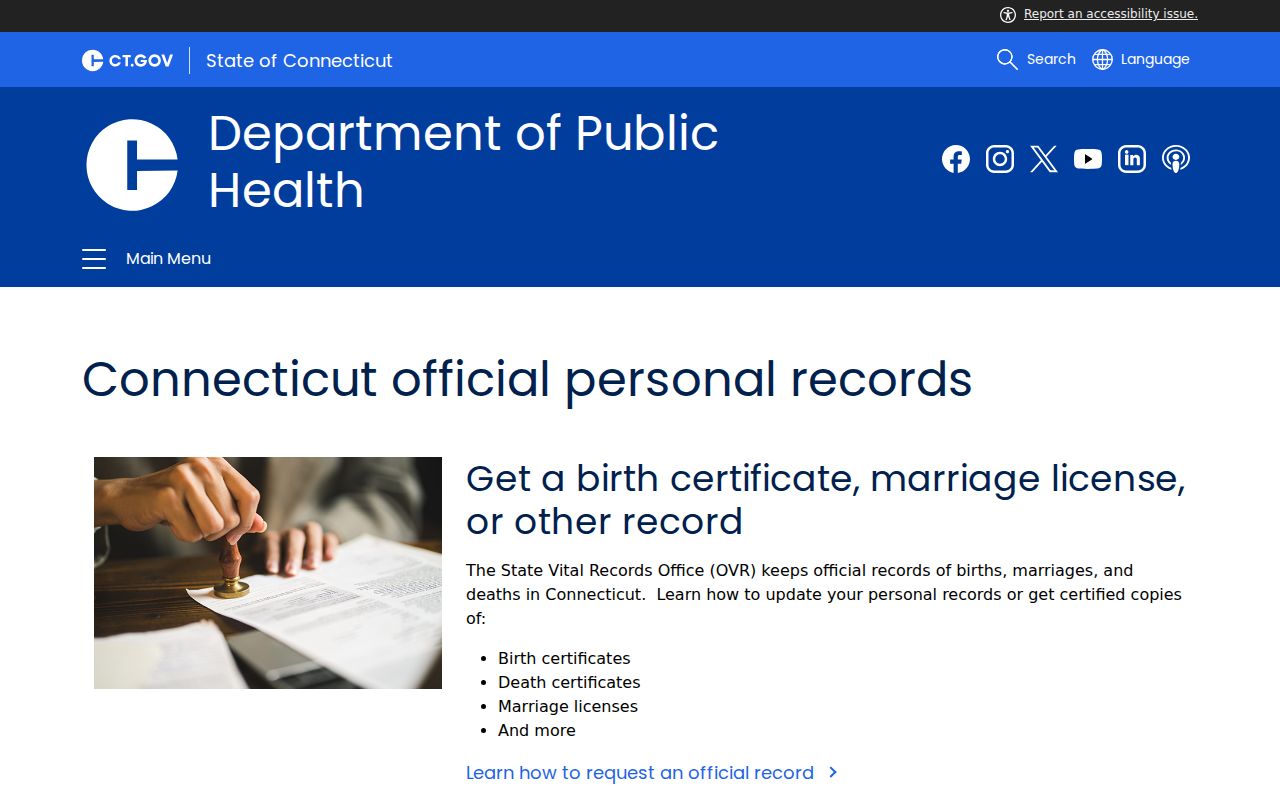
Local town clerks also issue marriage records, while a divorce decree comes from the Superior Court that entered judgment.
Connecticut Court Record Access
Connecticut's Freedom of Information Act begins with broad access to public agency records, but an adjudicative court file is not handled like a routine town-agency request. The Judicial Branch lookup and responsible clerk are the first channels for case material. Administrative Judicial Branch records may fall within the inspection and copy framework. Police arrest information, conviction data, erased cases, and juvenile matters each have more specific laws.
Key Connecticut laws:
CGS § 1-210 states the general right to inspect or copy public records, subject to exemptions.
CGS § 1-215 addresses public arrest information during a pending prosecution.
CGS § 54-142a governs erasure after qualifying dismissals, nolles, pardons, and convictions.
CGS § 46b-124 makes juvenile-matter records confidential except for listed access rights.
Restricted Connecticut Court Records
Juvenile and youthful offender matters do not appear in ordinary public criminal searches. Adoption records, mental health proceedings, sealed affidavits, and some family or probate material also receive special protection. Public copies can redact Social Security numbers, account numbers, the identities of minors, and protected victim addresses. The absence of an online result therefore does not prove that no case existed.
Criminal erasure can change what remains public. Not-guilty and dismissed matters become eligible under statutory rules, nolled charges have a waiting period, and pardons can trigger erasure. Connecticut also provides automatic erasure for eligible offenses after specified periods. A public lookup may change after an erasure, correction, or pardon. The clerk or State Police repository should address a claimed error in the system each controls.
Find Connecticut Records Locally
Connecticut abolished county government, so these links are routing areas rather than twenty-seven county governments. The directory combines eight historical counties with nineteen city and town record areas. Each local page helps match a town to the correct Superior Court location, municipal clerk, police records office, or Probate Court. That distinction matters when a statewide index shows a case but a document remains at a court counter.
Fairfield County
Bridgeport · Large metro region with several court venues
Hartford County
Hartford · Capital region with multiple state court locations
New Haven County
New Haven · Major judicial district and GA routing area
Hartford City
Hartford · State, probate, federal, and municipal channels
Bridgeport City
Bridgeport · Fairfield Judicial District and vital records
Stamford City
Stamford · Stamford-Norwalk and local clerk routing
Browse the full directory of all 27 Connecticut record areas to reach the local site that matches the town or historical county.
Connecticut Court Record Fees
Fees depend on the product and office. Under CGS § 1-212, covered state-agency paper copies can cost up to $0.25 per page, while other covered public agencies can charge up to $0.50 per page. Those ceilings do not automatically define every certified court product. A certified DMV driver history costs $20. A marriage license costs $50, and a certified marriage certificate costs $20 per copy.
| Item | Amount |
|---|---|
| Covered state-agency paper copy | Up to $0.25 per page |
| Other covered public-agency copy | Up to $0.50 per page |
| Certified DMV driver history | $20 |
| Certified marriage certificate | $20 per copy |
Probate costs are more specialized. The official Probate fee calculators provide estimates for petitions, estate matters, copies, and recording.
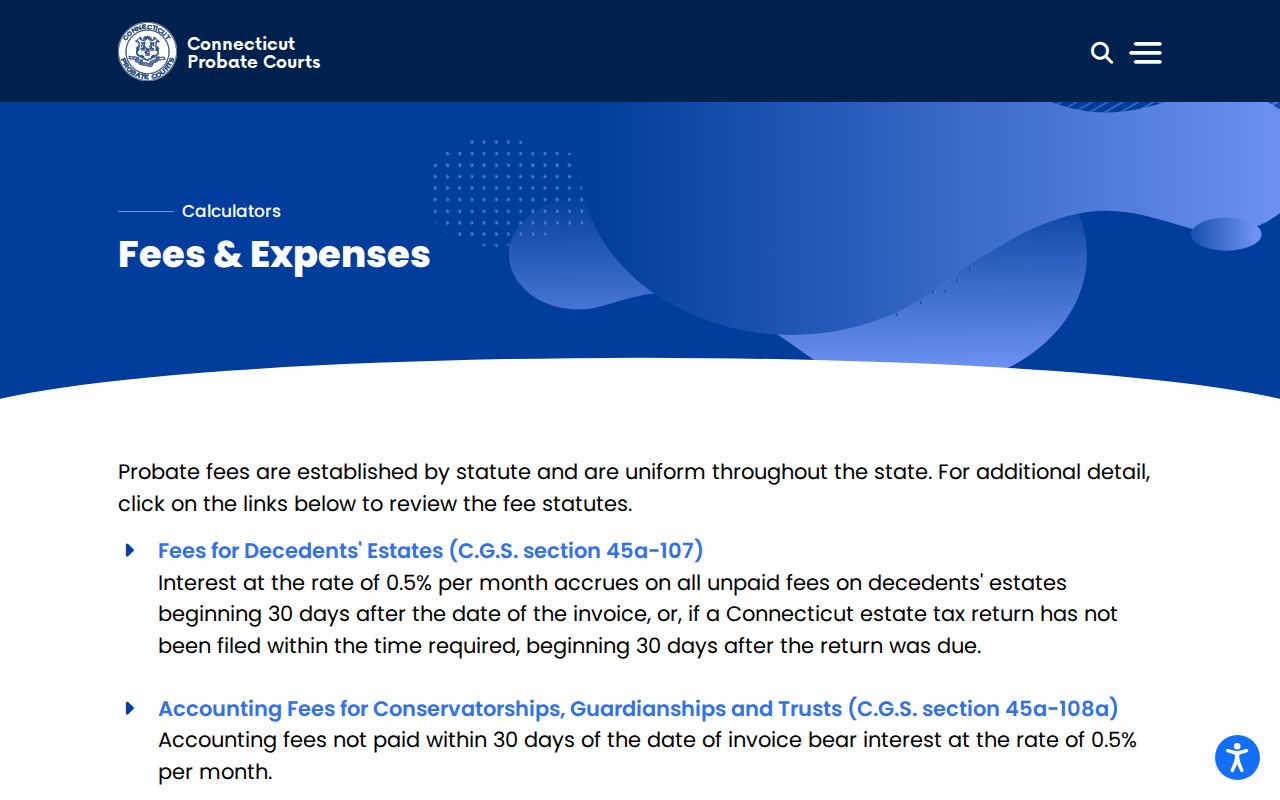
The Probate Court supplies the exact amount, so the calculator result is not a final invoice.
Interpret Connecticut Court Records
Pending means the case has not reached a final result. Disposed means court action ended the case or count at that stage, but it does not state how. A nolle means the prosecutor stopped pursuing a count at that time. Dismissed, not guilty, and guilty are distinct outcomes. An arrest allegation is not a conviction, and a custody entry does not prove guilt. Compare the filed charge with its final disposition and sentence.
For civil and family cases, CV and FA identify broad categories. Location prefixes identify the assigned court, while the filing year and sequence distinguish the case. A legal notice or docket line may be public even when the underlying filing is sealed or unavailable online. The clerk's certified judgment controls when a final legal result must be proved.
Federal Records in Connecticut
Federal cases use a different system. The U.S. District Court for the District of Connecticut manages its electronic docket through CM/ECF, while public users retrieve district, bankruptcy, and appellate records through PACER. Connecticut federal appeals go to the U.S. Court of Appeals for the Second Circuit. A state Judicial Branch search will not find these cases. Filings before the District Court's October 2003 conversion may require a records-center request rather than a normal online image.
The District Court's official federal case information page explains the CM/ECF and PACER relationship.
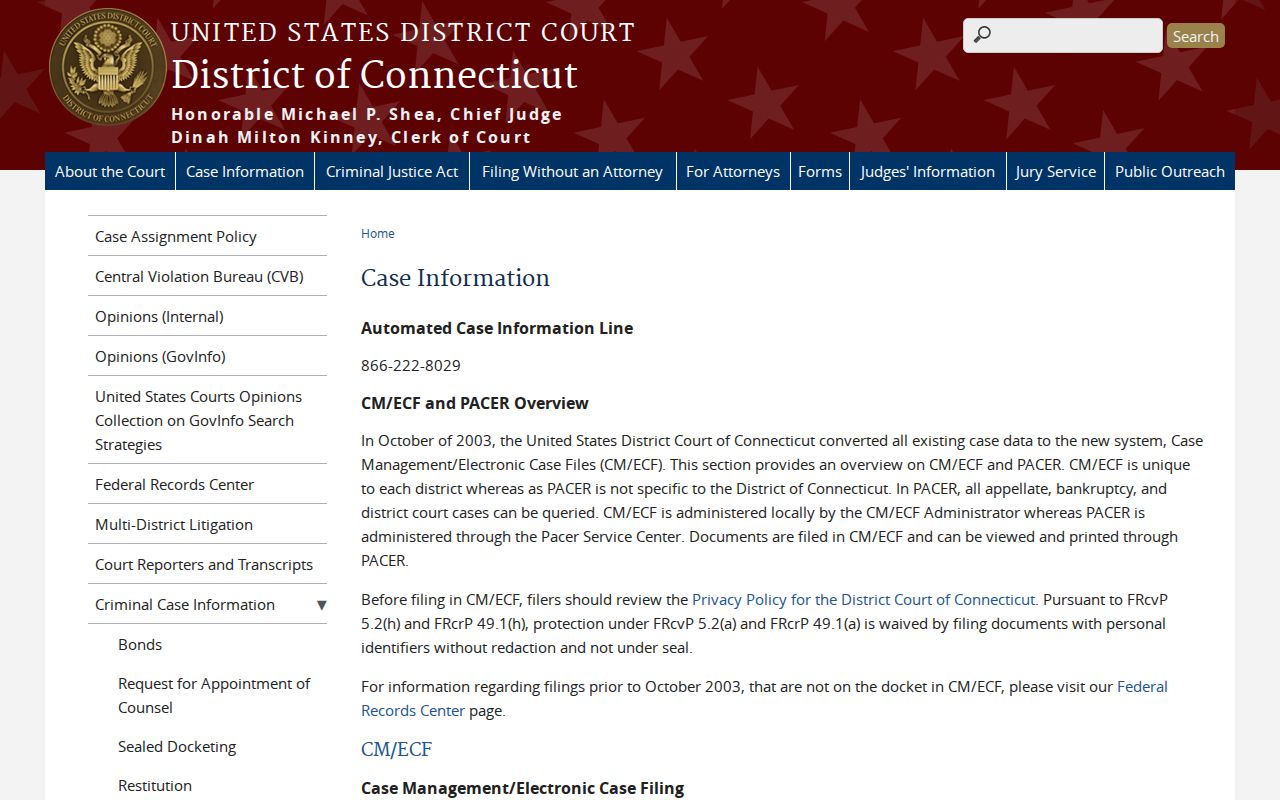
CM/ECF is the court's filing and case-management system; PACER is the national public-access service used to view and print available documents.
Connecticut Courts and Updates
Connecticut ended most county-government functions in 1960 and completed trial-court unification by 1978. Historical county names remain useful for geography, but modern access follows state court locations. Technology added separate civil and criminal lookup systems, probate eFiling, and a statewide DOC inmate search. Older or offline documents still require the responsible clerk or a public access computer.
A January 2025 official announcement illustrates Connecticut's statewide judicial appointment process.
A nomination is only one stage and does not establish that a nominee was later confirmed or seated.
The Supreme Court's On Circuit case program brings appellate argument and public case summaries to schools.
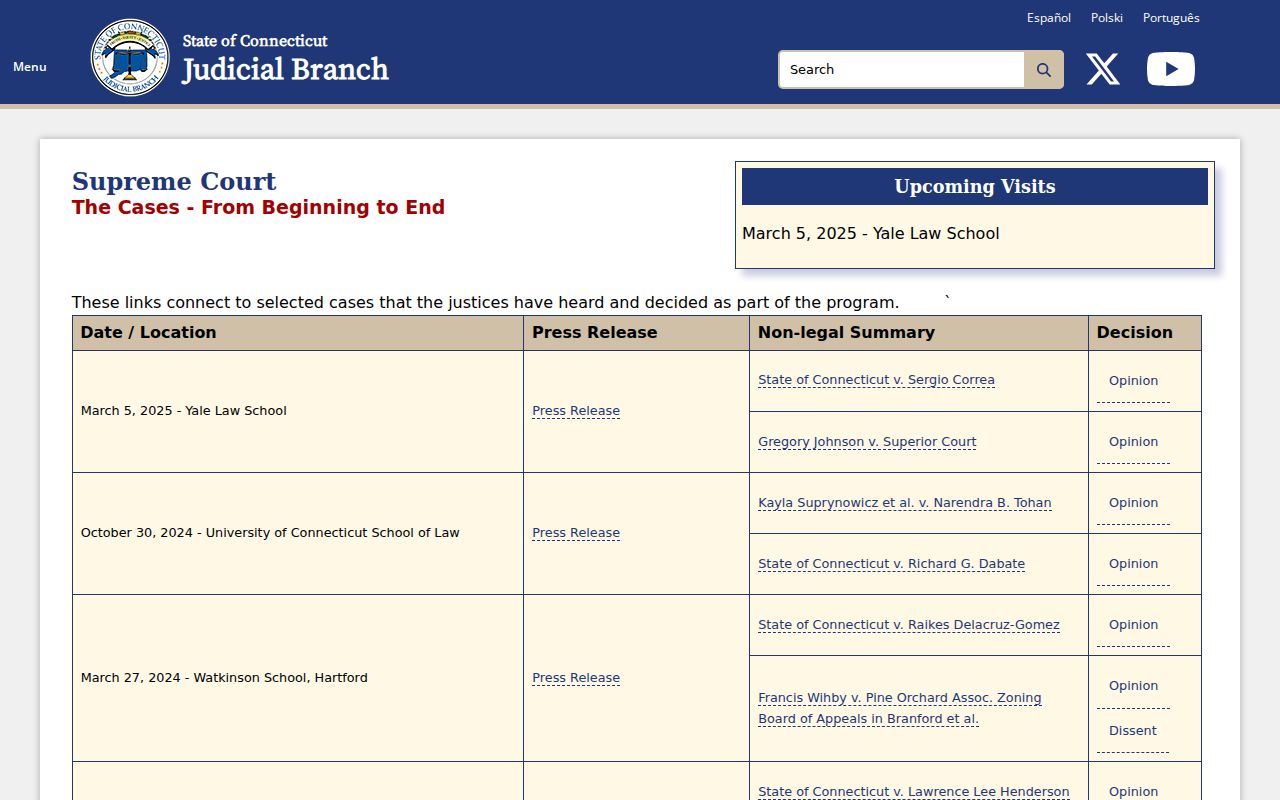
Those materials help readers follow the path from briefs and oral argument to an appellate opinion.
The Appellate Court publishes its own On Circuit case materials.
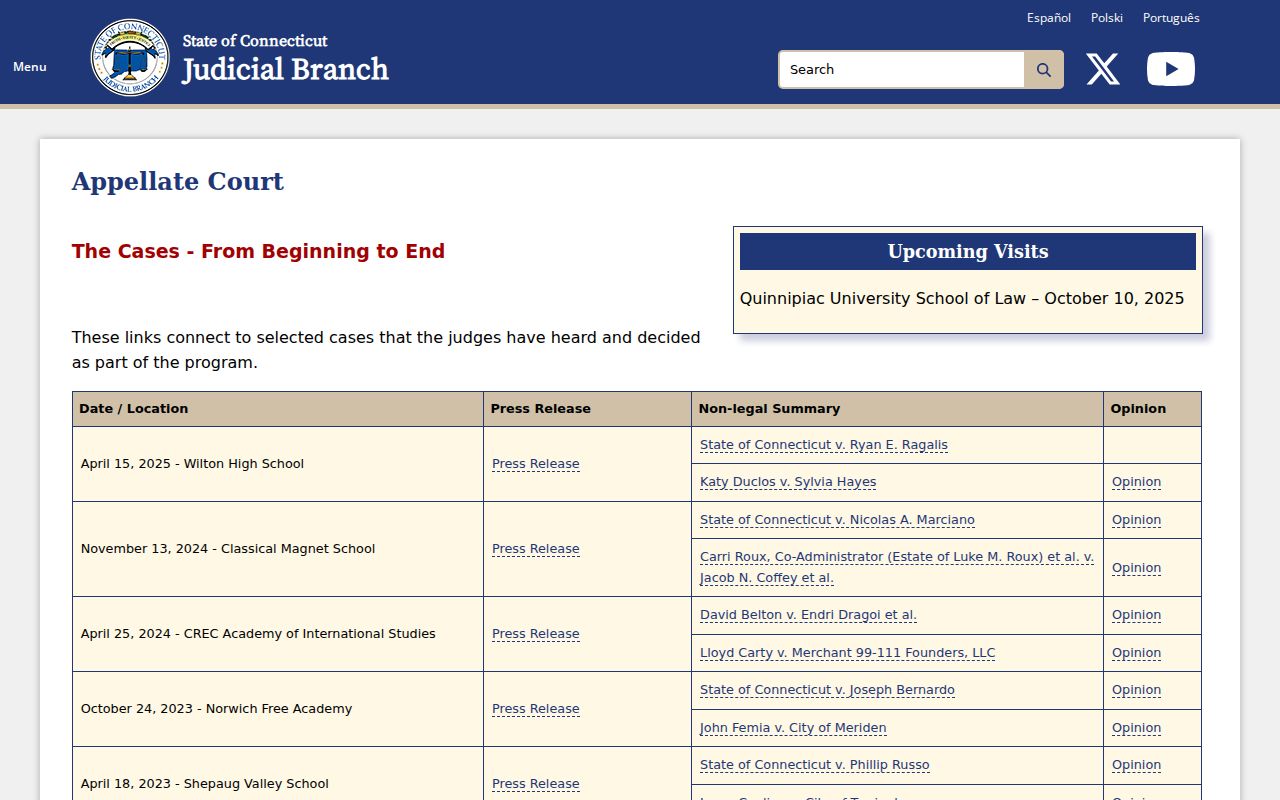
The separate pages reinforce that Connecticut has one statewide Appellate Court rather than regional appellate districts.
Connecticut Record Accuracy Limits
Online court information can lag behind a courtroom event. The criminal system warns that data can change after erasures, corrections, pardons, and other updates. DOC says inmate information is updated daily, but custody can change faster. Probate coverage before January 2011 is incomplete. E-filing also does not make every filed image open to anonymous public access.
Note: Confirm deadlines, warrants, custody status, and certified dispositions with the Connecticut office that controls the original record.
Connecticut Court Records Questions
Does Connecticut have county courts?
No operating county-court system handles modern cases. Superior Court is statewide, with cases assigned to judicial districts, Geographical Area courts, and special sessions. Historical counties remain geographic labels.
Can one portal search every record?
No. The Judicial Branch hub leads to separate civil, family, housing, small claims, criminal, motor vehicle, and appellate systems. Probate, DOC custody, DMV history, municipal marriage records, and federal cases use other systems.
Why is a case missing online?
It may be in the wrong case system, held under a different location code, too old for full digital coverage, sealed, erased, juvenile, or restricted. The clerk at the assigned court can explain access.
Where do certified records come from?
The office holding the original record issues the certified copy. That may be a Superior Court Chief Clerk, Probate Court, town vital records office, DPH, DMV, DOC, or another agency.