
Connecticut Arrest Records Explained
A municipal or state police arrest record may identify the arrest time, agency, asserted probable cause, initial alleged offenses, and identifying details. It remains with the arresting agency. If a person enters custody, the Connecticut Department of Correction creates a separate custody record because DOC operates the state's pretrial and sentenced facilities. Neither record states the final result of a prosecution.
The court charge record starts when the State, through a State's Attorney or assistant state's attorney, presents formal counts in Superior Court. Connecticut assigns the matter by town and court location, often a Geographical Area court, rather than through county government. Court charges after arrest may differ from police labels. Prosecutors may substitute, add, reduce, nolle, or dismiss counts as the case develops. The full Connecticut criminal case file adds pleas, motions, hearings, judgment, and sentence to those charge entries.
Search Connecticut Arrest Records
Begin with the record's owner. Ask the arresting police agency for the incident or arrest record and cite the person's name, approximate date, and incident number if known. Then use the pending criminal and motor-vehicle defendant search to find filed charges. Search results are organized by Superior Court location, not county. If the case is missing or a document image is unavailable, contact that location's chief clerk.
- Search the defendant's last-name prefix, first initial, birth year, likely court location, and Criminal case type.
- Copy the full docket number and confirm the name against available identifiers.
- Read every count, statute, plea, status, and disposition separately.
- Ask the chief clerk for the charging instrument and certified outcome when the web entry is not enough.
The search-form image comes from the official pending-case portal linked above.
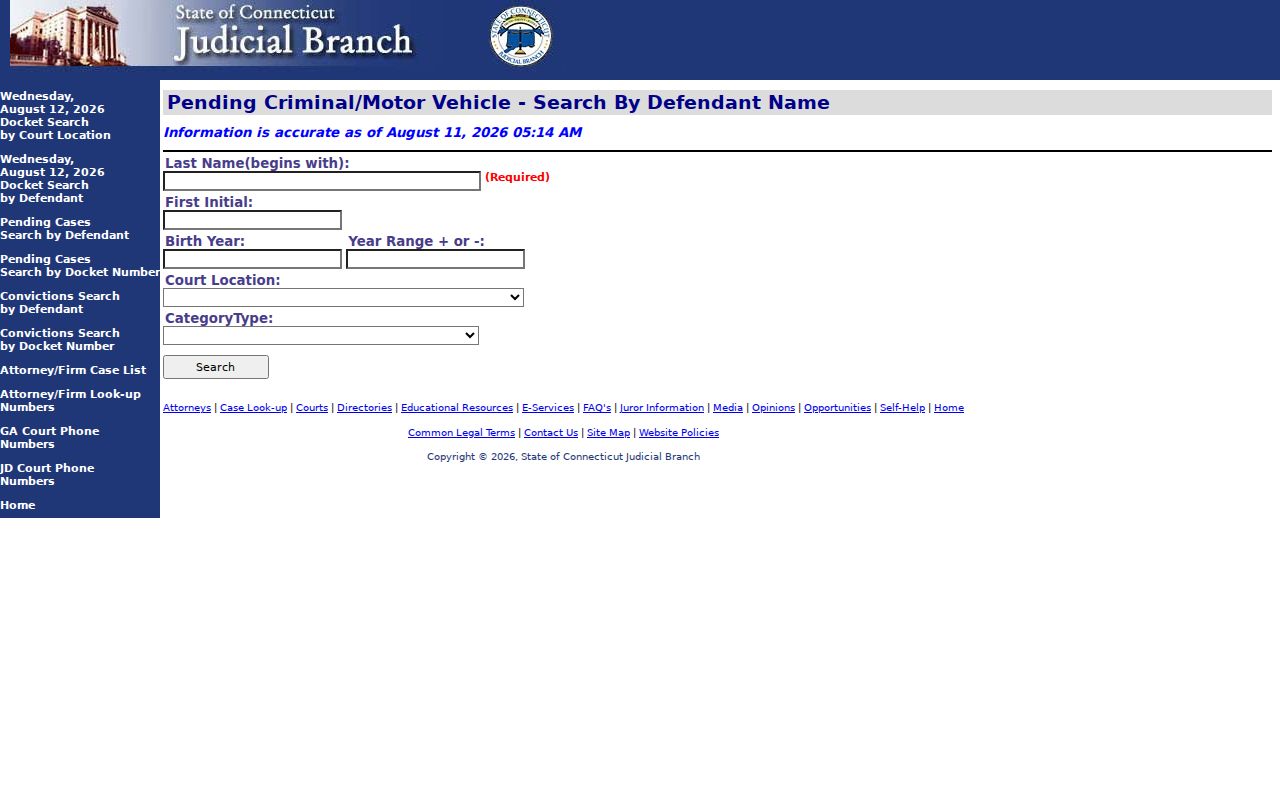
Its filters help locate a docket, but the form does not replace a police report, DOC custody result, or certified clerk copy. Use the Connecticut project-area directory to identify the correct local route when only the town or historical county is known.
When the probable-cause narrative is needed, request the arrest or incident report from the arresting police department. Give the agency enough detail to identify the event and ask whether any part is withheld or redacted. The courthouse clerk is the better source for the information, substitute information, public docket, and certified disposition. These requests can be made separately because no single Connecticut portal combines both source files.
Connecticut Charging Documents
An arrest-warrant application and affidavit can support probable cause before arrest. The operative court accusation is then stated through the document used in the case. A substitute information can change that accusation later. Some affidavits are temporarily sealed or redacted to protect an investigation, witness, minor, or other protected fact.
| Complaint | Information | Indictment | |
|---|---|---|---|
| Source | Police or prosecutor, depending on use | Prosecutor | Grand jury |
| Function | States allegations or supports initial process | States the formal trial-court accusation | States counts returned by a grand jury |
| Connecticut caution | Do not equate arrest wording with final counts | May be amended or substituted | Do not assume every felony uses one |
Connecticut Court Charge Status
A docket can contain several counts and several outcomes. “Pending” can coexist with release on bond. “Disposed” means the court completed the count or case at that stage, not that the accused was convicted. A continuance changes the schedule. It is not a result. Always compare the original count with the latest operative count and final disposition.
- Pending
- The accusation remains unresolved, even if the person is not in custody.
- Substituted or amended
- The operative accusation changed after filing.
- Dismissed
- The court terminated that count.
- Nolle
- The state is not prosecuting the count at that time; it is not an acquittal.
Connecticut Charges vs Convictions
An arrest and a filed charge are allegations. They are not findings of guilt. A conviction follows an accepted guilty plea or guilty finding and can support a sentence. Connecticut public access also treats conviction and nonconviction information differently. The result for one count cannot be applied to all other counts in the same case.
| Charge | Conviction | |
|---|---|---|
| Stage | Accusation | Verdict or plea |
| Burden of Proof | Probable cause | Beyond reasonable doubt |
| Result | May be changed, dismissed, nolled, or tried | Can lead to sentence and reportable history |
Connecticut Sealing vs Erasure
Connecticut calls its main removal process erasure. CGS §54-142a covers eligible not-guilty findings, dismissals, nolles after the waiting period, pardons, and qualifying convictions. A sealed record remains but is closed under law, rule, or order. An erased record is removed from ordinary public disclosure. Juvenile erasure follows a separate statute and requirements.
| Sealed | Expunged | |
|---|---|---|
| Visibility | Closed to ordinary public inspection | Removed from ordinary disclosure |
| Basis | Specific law, rule, or court order | Connecticut erasure statutes |
| Effect on search | May be absent or restricted | Should not appear as an ordinary public record |
Connecticut Charge Codes
Connecticut charge entries link an alleged offense to a statute and description. Crimes are commonly classified as felonies or misdemeanors, while infractions and violations receive different treatment. Some laws create unclassified offenses with their own penalties. A generic title does not establish the grade. Check the statute in effect on the alleged offense date. One arrest may produce several charges at different levels, each with its own plea and disposition.
The Division of Criminal Justice State's Attorneys page identifies Connecticut's statewide prosecution structure.
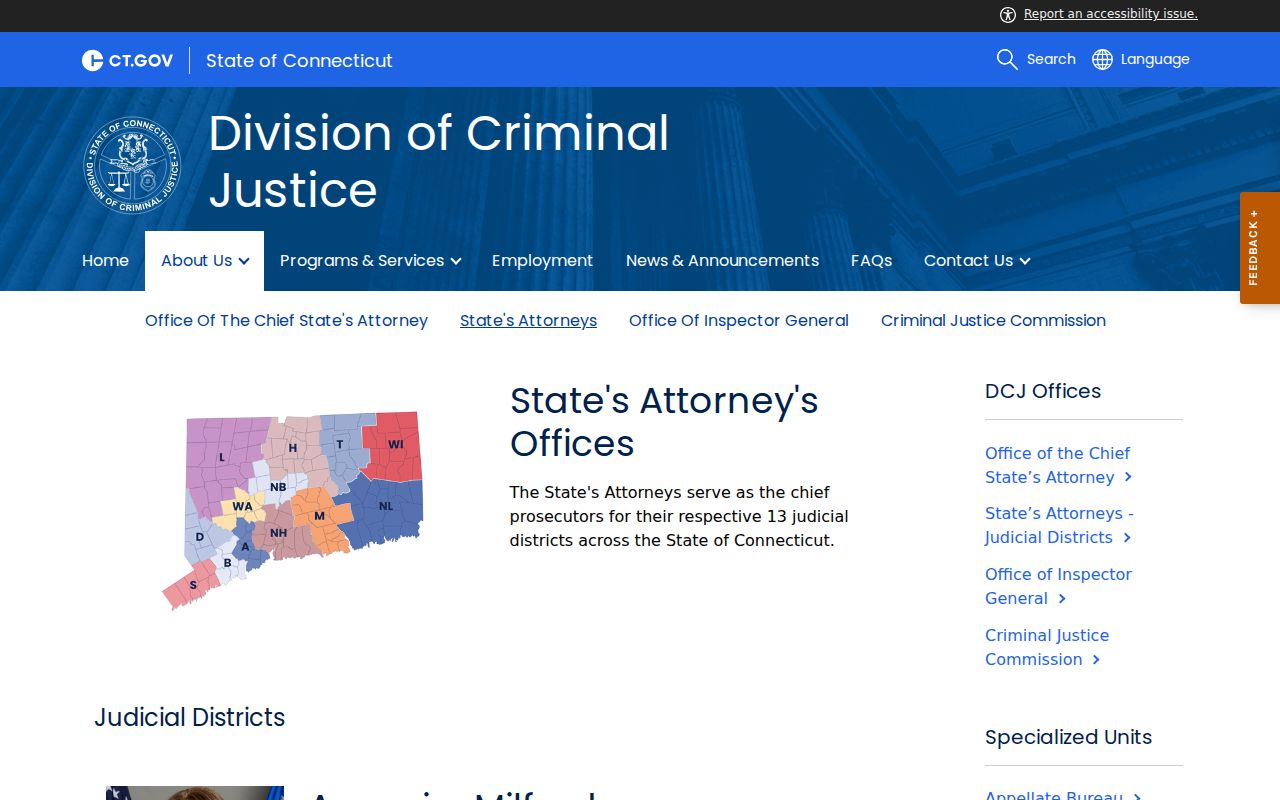
Connecticut uses State's Attorneys assigned through judicial districts and court locations, not county district attorneys.
Connecticut Statewide Criminal History
The State Police Bureau of Identification is the statewide criminal-history repository. An SBI response aggregates eligible reportable arrest, identification, charge, and disposition information. It is not the clerk's source file and does not provide every pleading, motion, or event. Name-based searches can produce false matches. Fingerprint-supported products are stronger for identity when offered or required. Product price and identity rules should be confirmed in the live official request system before payment.
Official State's Attorney releases illustrate public prosecution information outside the docket.
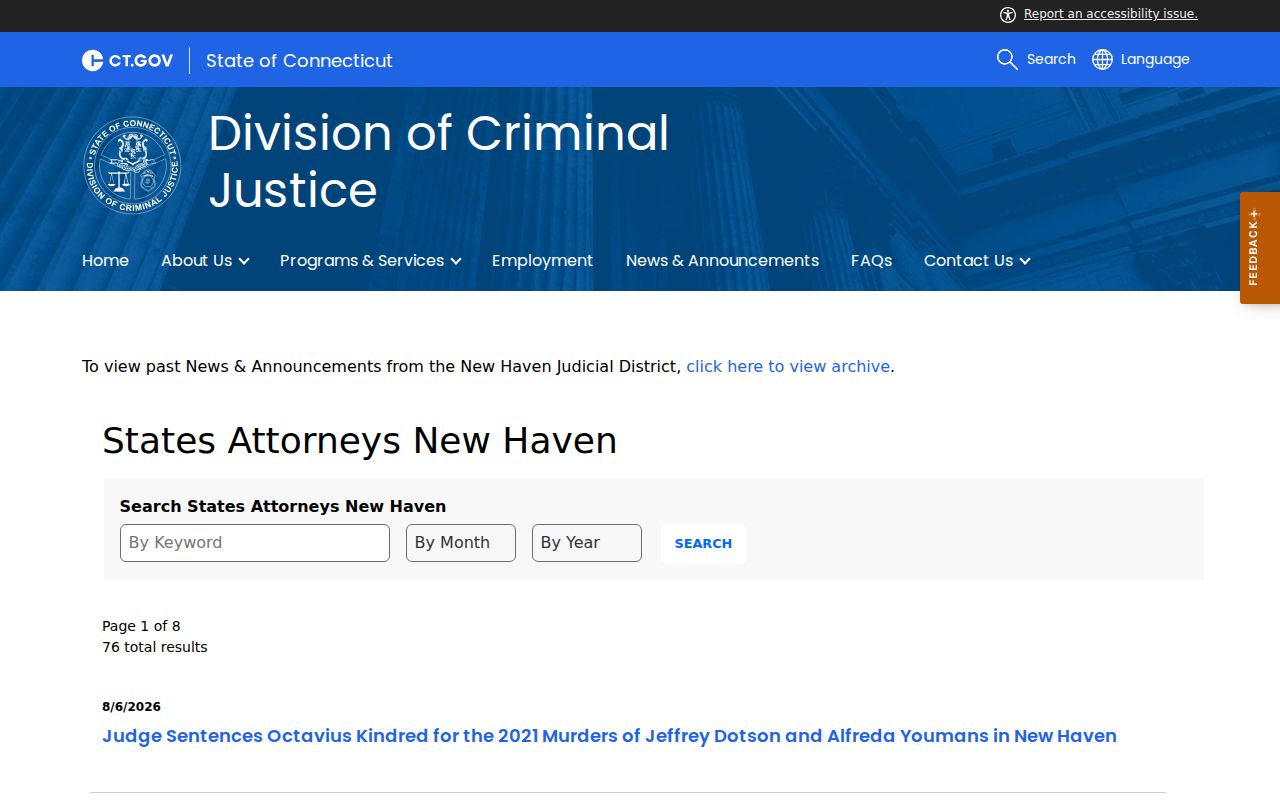
A news release can add context, but the filed docket and final judgment control the court record.
Connecticut Record Use Limits
A casual public lookup is not the same as a consumer report. Employment, housing, credit, insurance, and other regulated decisions can trigger the Fair Credit Reporting Act, including permissible-purpose and adverse-action duties. Court entries may be incomplete, stale, or linked to a person with a similar name. For a legal outcome, obtain the clerk's certified disposition and reconcile it with any SBI response.
Important: Public arrest and court-charge searches are not FCRA consumer reports and cannot be used for regulated eligibility decisions.
Restricted Connecticut Charge Records
CGS §1-215 treats defined arrest information as public during a pending prosecution, but law-enforcement exemptions and redaction duties still apply. Juvenile matters are confidential under CGS §46b-124. Youthful-offender cases are excluded from the public criminal lookup. Erased cases, sealed affidavits, victim addresses, minor identities, Social Security numbers, and financial account data may also be unavailable.
Missing data does not prove the absence of an arrest or charge. It may reflect erasure, a protected case, an unfiled police matter, an older offline record, or use of the wrong court location. Ask the source agency for the legal basis when access is denied.
Connecticut conviction information is generally public, while nonconviction information is mainly available to the subject and the subject's attorney under CGS §54-142k. That distinction is another reason to avoid treating a search result as a complete statewide account.
Access also depends on which source created the record. A municipal police department can address the public portion of its arrest or incident file. The assigned Superior Court Chief Clerk controls the filed information, docket entries, court orders, and certified disposition. DOC controls current custody information, while the State Police Bureau of Identification controls the statewide history product. A denial or missing field from one source should not be treated as a denial by all four. State the exact record and date sought, request the public portion if redaction is required, and ask for the legal basis when material is withheld.
Identity checks matter. Defendant-name searches accept a last-name prefix and can return people with similar names. Use the first initial, birth year, likely court location, and docket number to narrow the match, but do not publish protected identifiers. If the result will be used to prove the outcome of a charge, obtain a certified disposition from the courthouse and compare every count. SBI history, police arrest wording, and the court's final judgment can reflect different stages of the same event.
Note: Preserve original and final counts because a substituted information can make the filed accusation differ from the arrest label.