
Connecticut Offices by Record
Connecticut uses municipal registrars, the Department of Public Health, and state Superior Court clerks. A town or city vital records office issues the license for a ceremony in that town and records the returned certificate. DPH can issue eligible certified marriage or civil-union certificates. DPH explicitly states that it does not maintain divorce decrees. The clerk of the Superior Court that granted a dissolution, legal separation, civil-union dissolution, or annulment holds the judicial case file and decree.
The distinction also controls search terms. A marriage certificate proves a recorded vital event. A divorce docket traces a court case, and the decree is the judgment ending the marriage or civil union. Ordering a marriage certificate from DPH will not reveal the motions, parenting orders, or financial rulings in a later divorce. Searching a family docket will not produce the couple's municipal marriage license.
Quick Reference:
New marriage license: Registrar or town/city clerk for the ceremony town.
Certified marriage certificate: DPH State Vital Records Office or an eligible municipal vital records office.
Divorce case file and decree: Superior Court clerk where the divorce was granted.
DPH divorce role: Guidance and routing only; DPH does not keep divorce decrees.
| Record | Original Issuing / Filing Office | Certified Copy Source |
|---|---|---|
| Marriage license | Town or city registrar for ceremony town | Issuing municipal office |
| Marriage certificate | Municipal registrar after return | DPH or eligible town vital records office |
| Divorce petition and file | Connecticut Superior Court | Clerk at the granting court |
| Divorce decree | Connecticut Superior Court | Clerk at the granting court, not DPH |
Connecticut Marriage Licenses
Apply through the vital records office for the Connecticut town where the ceremony will occur. This is not a county-clerk transaction. Contact the local registrar before traveling to confirm appointment, identification, and payment rules. The statewide guidance documents a $50 license fee. After the ceremony, the officiant's return allows the municipal office to record the marriage and issue certified certificates.
A certified copy is not a new license. Anyone at least 18 may buy a certified Connecticut marriage certificate, but Social Security numbers are omitted from ordinary copies. Only the spouses may receive copies that include their Social Security numbers.
Connecticut towns also retain records for events occurring in the town and may keep copies for Connecticut events involving town residents at the time of the event. That rule can create more than one valid municipal request path. When the event town is known, it remains the clearest starting point. If it is unknown, use DPH's statewide route with the most complete names and date information available.
Apply for Connecticut Marriage License
Begin with the ceremony town, not a historical county name. Local forms and appointment practices can differ, so verify details with the registrar.
- Identify the Connecticut town where the ceremony will occur.
- Contact that town or city vital records office for current appointment and ID rules.
- Complete both parties' identity and ceremony information.
- Pay the $50 marriage-license fee.
- Follow the registrar's issuance and ceremony instructions.
- Have the completed license returned for recording.
- Order certified certificates from the town or DPH when needed.
Connecticut Marriage Application Fields
The captured statewide inventory is partial. Municipal forms require both applicants' identity information and the ceremony town. The registrar verifies identity, accepts the statutory fee, and applies local form instructions. Request the current town form instead of relying on an old copy.
| Field | Required | Notes |
|---|---|---|
| Applicant names | Yes | Use identity information required by the registrar. |
| Identification | Yes | Confirm acceptable documents locally. |
| Ceremony town | Yes | Controls the issuing municipal office. |
| License fee | Yes | $50 under statewide guidance. |
| Certified-copy request | Optional | Separate $20 certificate product. |
| Social Security information | Protected | Withheld except on copies issued to spouses. |
Connecticut Marriage Record Fees
Connecticut's documented marriage-license fee is $50, and a certified marriage or civil-union certificate costs $20 per copy. Divorce filing and certified-decree charges depend on the current Superior Court schedule and product. The research did not establish one reliable decree-copy amount, so confirm it with the granting court.
| Item | Amount | Where Paid |
|---|---|---|
| Marriage license | $50 | Town or city registrar |
| Certified marriage or civil-union certificate | $20 per copy | DPH or eligible municipal office |
| Divorce filing | Case specific | Connecticut Superior Court |
| Certified divorce decree | Confirm with clerk | Superior Court that granted the divorce |
Search Connecticut Marriage Records
Use the DPH ordering instructions for the state request channels, or contact the town vital records office tied to the marriage event or a spouse's residence at the time. Supply both spouses' recorded names, the marriage date or a narrow range, and the Connecticut town. Ask whether the intended use calls for a certified certificate or a copy from the municipal record.
The official ordering route is shown in this source capture.
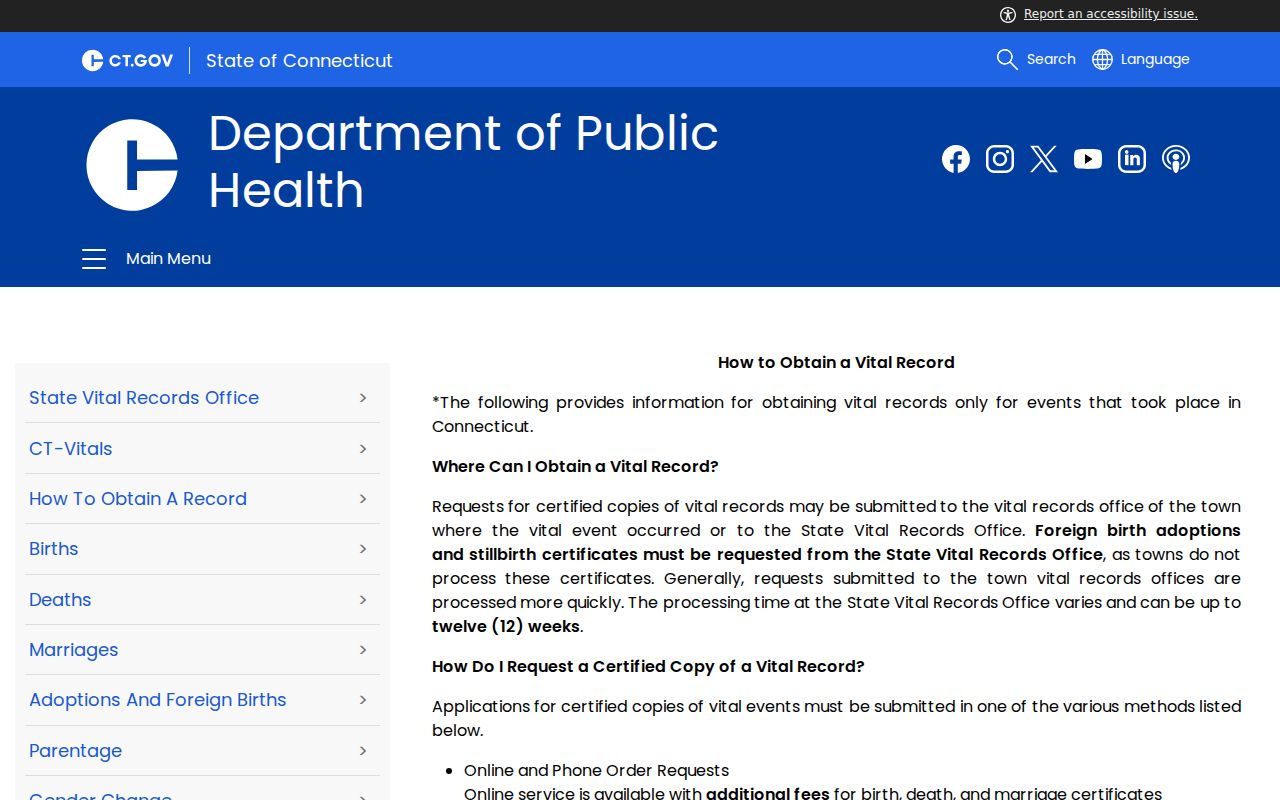
The state process offers a broad certificate channel, while the relevant town remains the best source for its locally recorded event.
Find Connecticut Divorce Records
Search the Judicial Branch Civil/Family/Housing/Small Claims system by party or docket. Family case types include F00 dissolution, F05 nonadversarial dissolution, F10 legal separation, F20 annulment, and F50 civil-union matters. Choose the FA case category when narrowing. A docket result can identify the court and case number, but the clerk at the granting Superior Court is the source for a certified decree and older or nonpublicly imaged documents.
Divorce files may contain a complaint, appearances, motions, parenting or support orders, financial affidavits, judgments, and the final decree. Confidential financial, child-related, sealed, or redacted material does not become public merely because the docket is searchable.
A party-name search supports last name, first name, location, family category, and a case-type filter. A docket search uses location, FA category, year, and sequence or the full docket number. If several results share a name, compare the court location and filing details. For an older case or a missing image, give the clerk the docket number and identify the exact decree or order needed.
The DPH divorce page states the office does not maintain decrees.
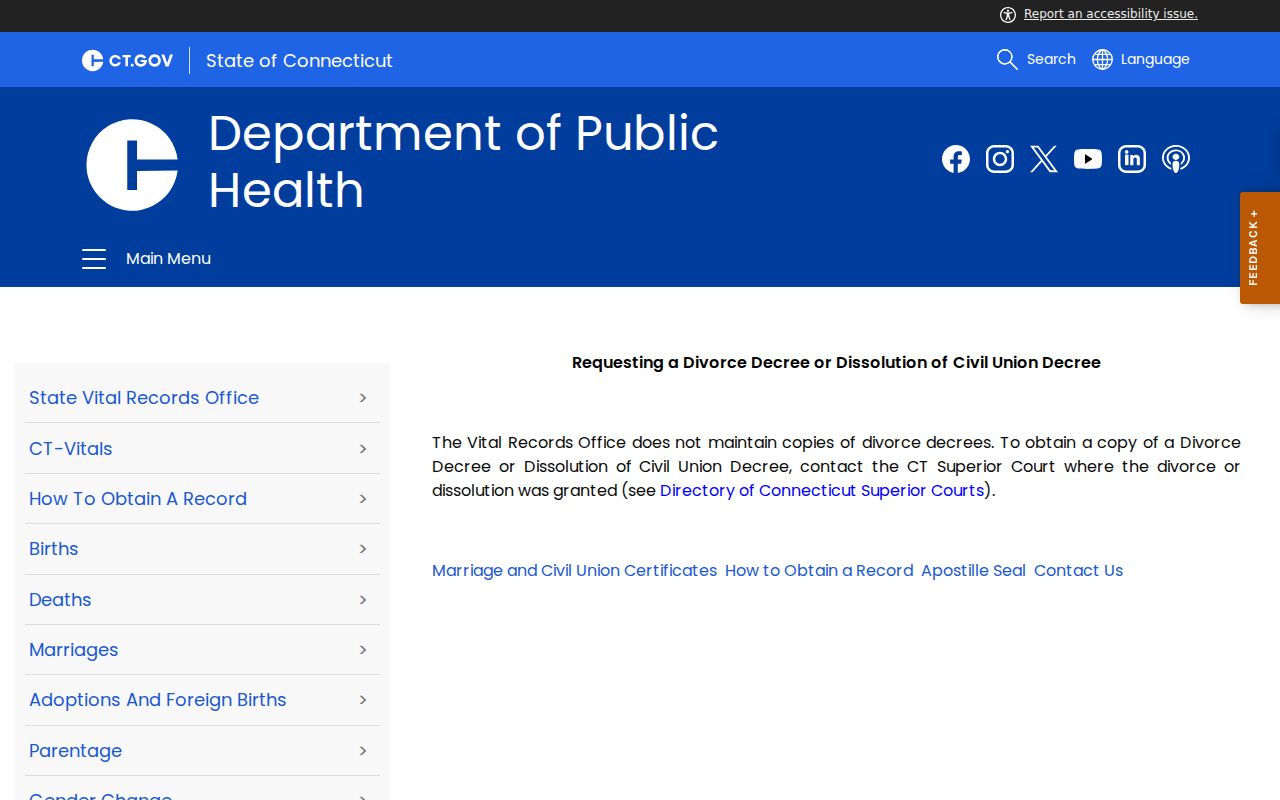
That division prevents requesters from paying the wrong office for a document DPH cannot issue.
Certified Connecticut Record Copies
For marriage proof, request a certified certificate from DPH or an eligible town vital records office. For a divorce judgment, request the certified decree from the Superior Court clerk that granted it. State vital-record ordering may be available through mail, office, and an authorized online channel listed by DPH. An online case lookup is not a certified legal copy.
- Decide whether the needed document is a marriage certificate or a court decree.
- Gather recorded names, date, town, or Superior Court docket details.
- Use DPH or the municipal registrar for marriage records.
- Use the granting Superior Court clerk for divorce decrees.
- Provide identification, eligibility proof, and the office's current fee.
Connecticut State Vital Records
The Connecticut Department of Public Health State Vital Records Office is the statewide marriage-certificate source documented in the research. Anyone at least 18 may purchase a certified marriage certificate. Ordinary copies omit spouses' Social Security numbers. Only the parties may receive a version containing those numbers. Requesters must follow the current identification and ordering rules for the chosen channel.
The DPH marriage and civil-union guidance is captured here.
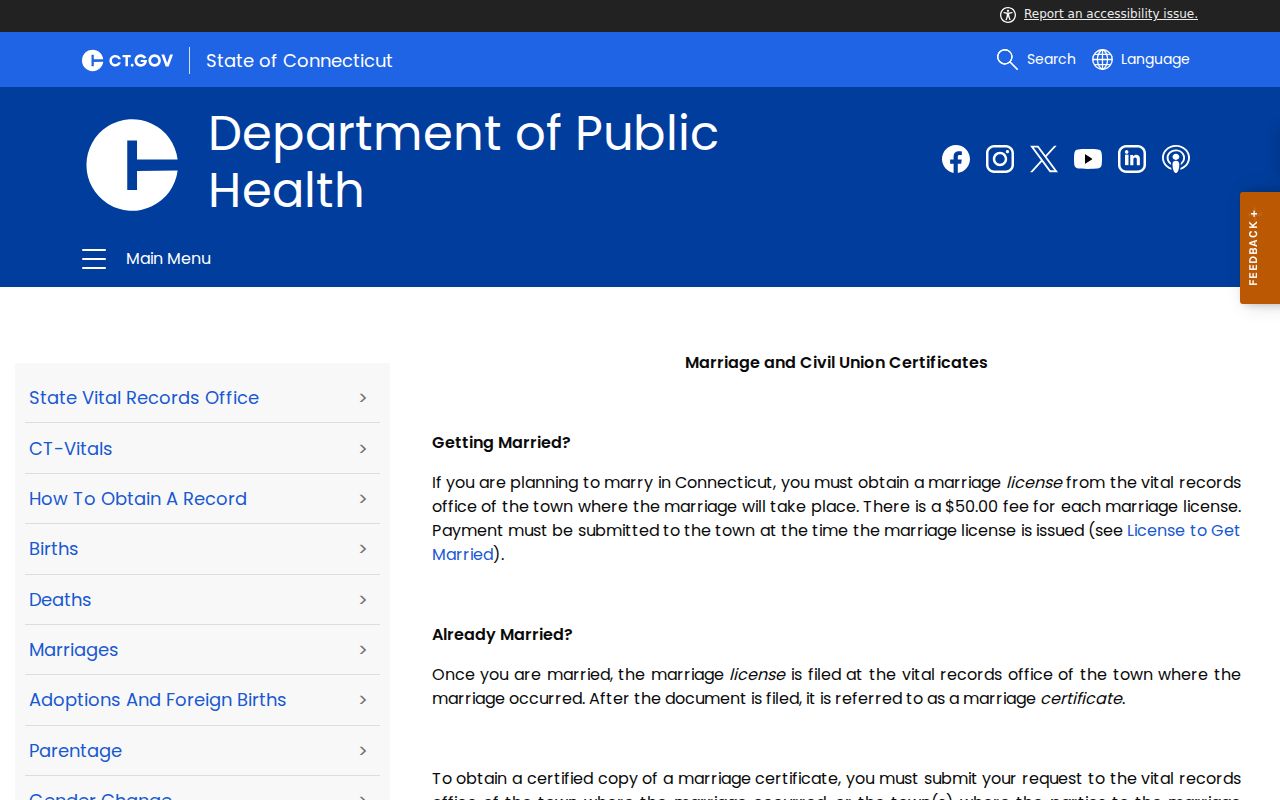
It documents certificate access and the distinction between a marriage-license fee and a later certified-copy fee.
Agency names matter. A Department of Correction contact page, for example, serves attorney and professional visits and does not issue vital or divorce records.
The DOC professional visit page provides that separate context.
Use DPH, the municipal registrar, or the Superior Court clerk rather than an unrelated state-agency contact channel.
Vital Records vs. Court Records: DPH and municipal registrars issue marriage certificates. Only the granting Superior Court clerk issues a divorce decree.
Connecticut DPH State Vital Records Office
Statewide marriage certificate requests
Follow the official page for current mail, office, and online channels.
Route Connecticut Local Records
Connecticut abolished operational county government, so there is no county clerk holding all marriage and divorce files. Use the 27-area Connecticut directory to identify the town vital records office or assigned Superior Court region. For marriage records, start with the ceremony town. For divorce records, start with the court location shown by the family docket and ask its chief clerk for the decree.