
Connecticut Criminal Case Files
A criminal case file begins when the state files an accusation in Connecticut Superior Court. It is held by the chief clerk at the court location assigned to the matter, not by a county clerk. Connecticut abolished county government and uses state-run trial courts. Geographical Area courts handle arraignments and much criminal and motor-vehicle work. Judicial District locations handle serious criminal matters and other assigned proceedings. The file may include the information or complaint, count-by-count charges, bond orders, appearances, motions, hearing entries, pleas, trial events, judgments, and sentencing papers.
The court file differs from Connecticut arrest records and filed charges. A police record describes the investigation and arrest. A DOC custody record describes confinement, transfer, or release. The clerk's case file shows what happened in court. A statewide SBI history is a fourth product that compiles reportable identity, arrest, and disposition data. Researchers should identify which question they are trying to answer before selecting a system.
Search Connecticut Criminal Records
The Judicial Branch Criminal and Motor Vehicle Case Look-up separates pending matters from convictions. Pending searches accept a defendant name or a docket number. The name form supports a last-name prefix, first initial, birth year, court location, and case type. A docket lookup uses the court code, CR or another case type, two-digit year, number, and suffix. Public results may show the court, charges, dates, events, and disposition, but a result is not a certified judgment.
- Run the pending defendant search using the narrowest reliable name and birth-year details.
- Filter by likely Superior Court location, then repeat without that filter if no match appears.
- Copy the complete docket number and open every count and event shown.
- Run the separate conviction search because pending and conviction displays serve different purposes.
- Contact the assigned chief clerk for the charging paper, judgment, or certified disposition not displayed online.
Older, erased, sealed, youthful-offender, and juvenile matters may not appear. Connecticut conviction information is also subject to the public display period stated by the Judicial Branch. The Connecticut project-area directory routes readers to local court-location details. Its 27 entries represent eight historical counties and 19 municipal record areas, not 27 legal counties.
Connecticut Criminal Case Stages
A Connecticut prosecution may change as prosecutors review the proof and statutory elements. The arrest label is not always the filed count, and a substitute information can amend the operative accusation. Each event leaves a different docket trace. A continuance changes a date but does not decide a charge. A nolle means the state is not prosecuting that count at that time. It is not an acquittal. Researchers should follow each count to its own result.
Case flow: Charges Filed › Arraignment › Pretrial / Motions › Plea or Trial › Disposition › Sentencing
- Arraignment
- The court states the filed charges and addresses counsel, release, and bond conditions.
- Pretrial and motions
- Appearances, continuances, discovery disputes, bond review, and motions create dated entries.
- Plea or trial
- Each count may end by plea, verdict, dismissal, nolle, or another authorized result.
- Disposition and sentence
- The record identifies the outcome and any incarceration, probation, fine, restitution, or conditions.
What Connecticut Criminal Records Show
Public Connecticut criminal court records organize the case around a location-coded docket. Exact fields vary by status and disclosure rule. Document entries may identify papers without providing the image, so a docket can confirm that a motion exists while the clerk remains the source for inspection or a copy.
| Field | What It Shows |
|---|---|
| Docket number | Court code, case type, year, sequence, and suffix that identify the file. |
| Defendant | Public name and limited identifying details used to distinguish matches. |
| Charges | Statute, description, count, and changes such as substitution or dismissal. |
| Plea and events | The formal response plus arraignments, hearings, motions, and continuances. |
| Disposition | The current or final result for each count, not merely the case-level label. |
| Sentence | Penalty and conditions imposed after a conviction, when publicly displayed. |
Connecticut Charges and Convictions
A charge is an accusation. A conviction is a judgment based on a guilty plea or finding. One Connecticut docket may hold several counts with different results, including guilty, dismissed, nolled, or not guilty. The word “disposed” only means the court completed a matter at that stage. It does not reveal which outcome occurred. Read the line for each count and obtain the final judgment when legal proof is needed.
| Charge | Conviction | |
|---|---|---|
| Stage | Accusation | Verdict or plea |
| Burden of Proof | Probable cause | Beyond reasonable doubt |
| Meaning | Does not establish guilt | Establishes guilt unless later vacated or erased |
Read Connecticut Case Outcomes
Common Connecticut results include guilty, not guilty, dismissed, and nolled. A nolo contendere plea, when accepted, can support judgment without the defendant admitting the facts in the same terms as a guilty plea. Sentence entries can cover confinement, probation, financial orders, and special conditions. Later events may include a violation of probation, appeal, correction, pardon, or erasure. Compare the sentence date with the disposition date and do not infer present custody from an old judgment.
The Division of Criminal Justice statewide roster shows how State's Attorneys are assigned by judicial district. Connecticut uses State's Attorneys, not county district attorneys. The roster image below illustrates that statewide prosecution structure.
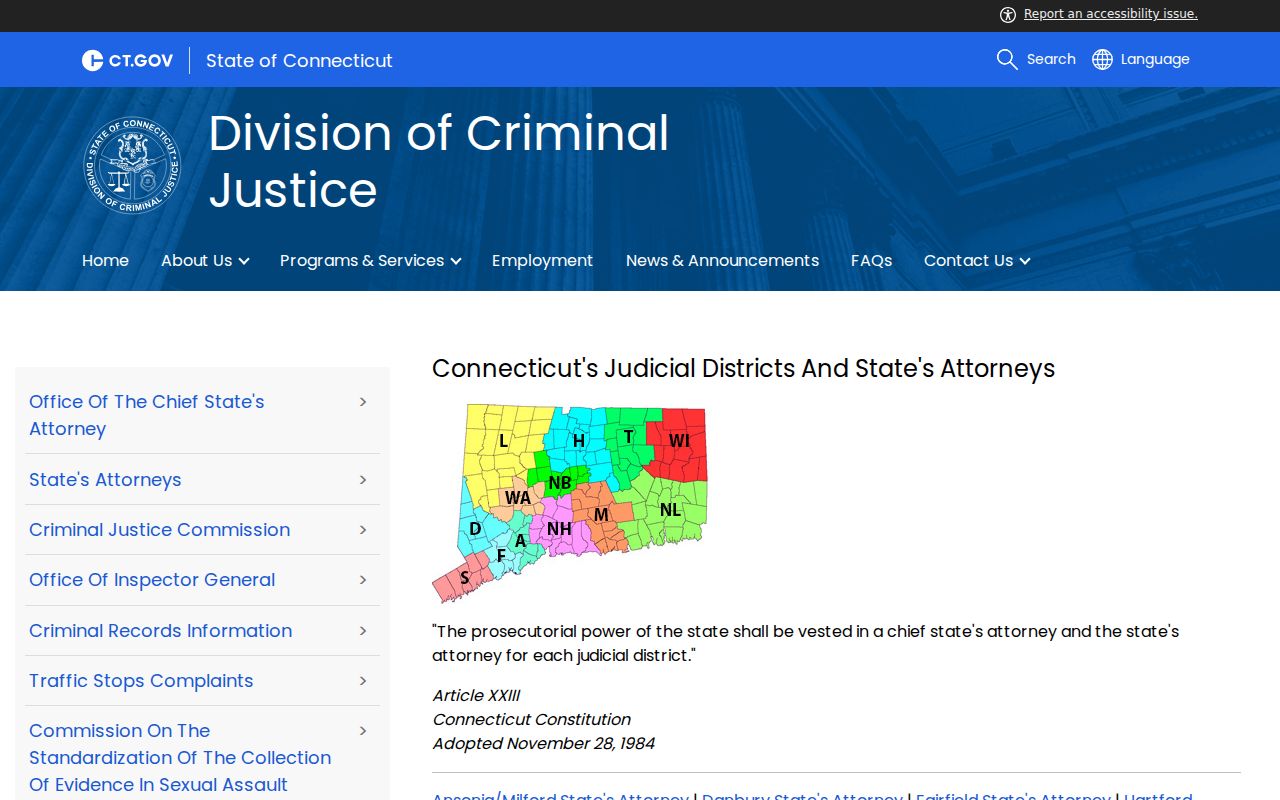
The assigned prosecutor may file or amend charges, while the chief clerk remains the keeper of the court docket and public case documents.
Connecticut Sealed and Erased Records
Connecticut law usually uses “erasure,” not the generic term expungement. Under CGS §54-142a, qualifying not-guilty findings, dismissals, nolles after the statutory period, pardons, and eligible convictions may be erased. A sealed record still exists but is closed under a rule or order. An erased record is treated as removed from ordinary public disclosure. Automated erasure also exists for qualifying cases, but exclusions and completion of sentence or supervision conditions matter.
| Sealed | Expunged | |
|---|---|---|
| Public visibility | Closed by law, rule, or court order | Removed from ordinary public disclosure |
| Record status | Still exists under access limits | Treated as erased under the governing statute |
| Connecticut examples | Protected affidavits or confidential material | Eligible dismissals, nolles, pardons, and convictions |
Connecticut Criminal Record Access
Public access to adjudicative court files follows Judicial Branch rules and the status of the document. Connecticut FOIA supplies a broader framework for covered agency and Judicial Branch administrative records, but a request for a plea, order, or judgment normally goes to the responsible court clerk. Inspection, plain copies, and certified copies serve different needs. State-agency paper copy ceilings under CGS §1-212 do not automatically define every adjudicative court-copy charge.
Key Statutes:
CGS §54-142k makes conviction information public while limiting nonconviction information mainly to the subject and counsel.
CGS §46b-124 makes juvenile-matter records confidential except for defined access categories.
The official State's Attorney profile provides a representative view of a judicial-district prosecution office.
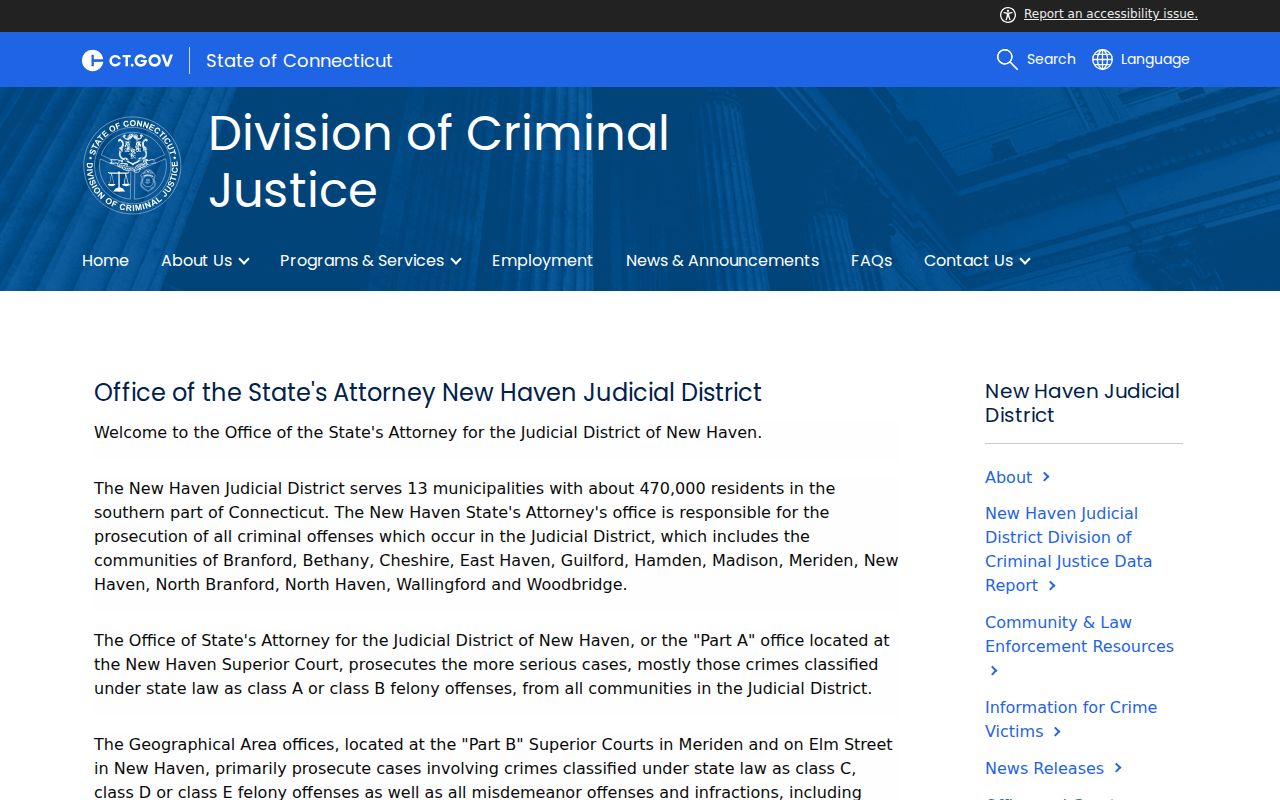
That office structure helps explain why filed criminal cases are routed by judicial district and Geographical Area rather than by a county prosecution office.
Connecticut Statewide Criminal History
The State Police Bureau of Identification is Connecticut's statewide criminal-history repository. Its report aggregates eligible arrest and disposition information supplied by agencies. It does not provide the pleadings, motion history, or full procedural docket found in a clerk's file. Name and date-of-birth searches can produce false matches, while fingerprint-supported requests offer stronger identity matching where available. Nonconviction information remains restricted even when conviction information is public.
Important: A public court lookup is not an FCRA consumer report and cannot support regulated employment, credit, insurance, or housing decisions.
The Connecticut Division of Public Defender Services is distinct from both the clerk and SBI.
Public defenders represent eligible accused people; they do not operate the public criminal-record repository.
Restricted Connecticut Criminal Records
Juvenile matters, youthful-offender cases, erased records, sealed material, and protected personal identifiers do not belong in ordinary public results. Social Security numbers, financial account data, minor identities, victim addresses, and some affidavits may be withheld or redacted. A missing online result therefore does not prove that no case ever existed. It may reflect a restriction, an erasure, an older offline file, or a search mismatch.
The official Geographical Area public-defender office page shows one support office tied to a court location.
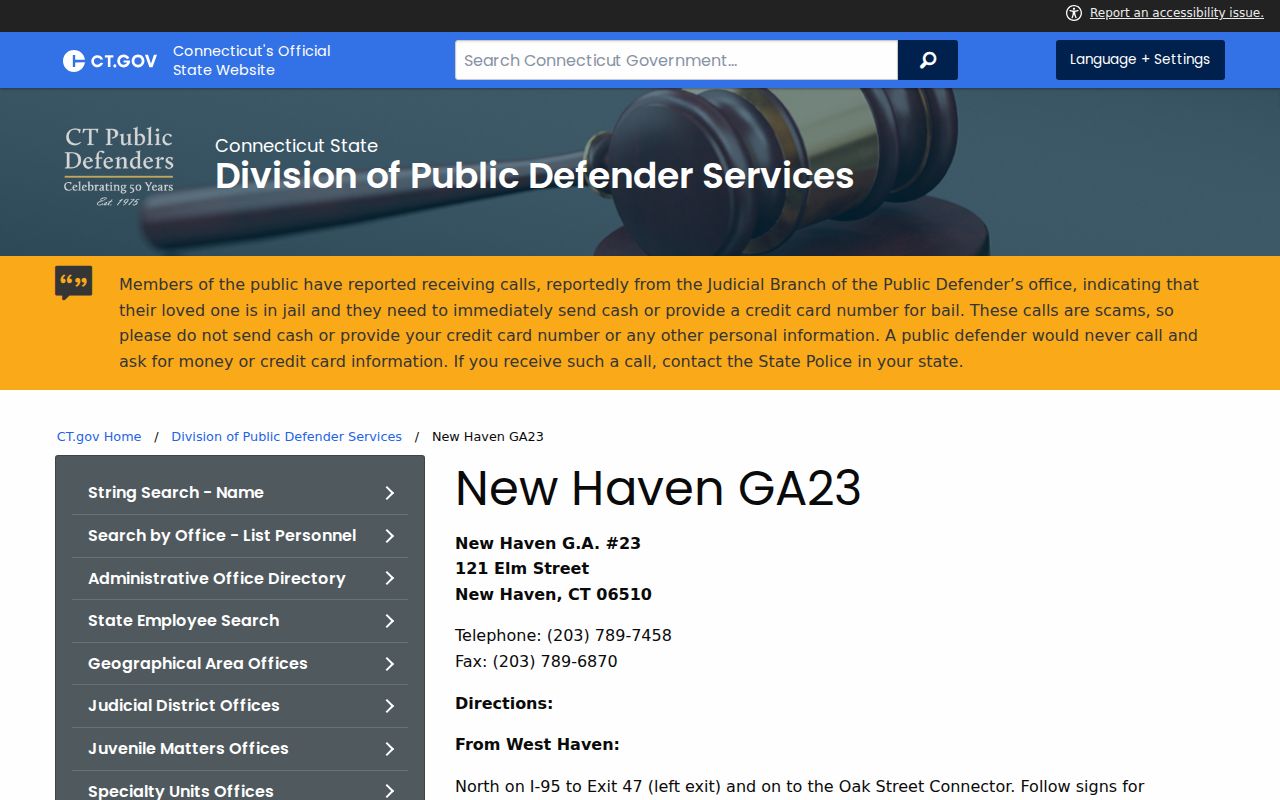
For a public document, identify the location code and ask that courthouse's chief clerk, not a historical county office, about inspection and certification.
Supply the docket number, defendant name, approximate year, and exact document title. Ask whether the public copy is electronic, paper, redacted, or available only at the clerk counter.
Note: Verify each count against the final judgment because a pending charge, an arrest label, and a conviction are not interchangeable.