
Connecticut Active Warrant Limits
Connecticut judges issue arrest and bench warrants through the state court system. Police officers may seek an arrest warrant through a sworn application and probable-cause affidavit. A court can issue a bench warrant when a defendant fails to appear or disobeys an order. Municipal and state law-enforcement agencies execute warrants, while the Superior Court docket records related case events when public.
No official statewide active-warrant roster was found in the research. A criminal docket can show a missed date, court location, or event linked to a warrant, yet it is not guaranteed to confirm every active warrant. Connecticut's eight counties are historical areas, not operating sheriff jurisdictions. The Connecticut project-area directory helps route a search to the correct municipality and court location among 27 project entries.
Connecticut Warrant Types
The issuing authority and public access depend on the warrant's purpose. Do not assume that every warrant is connected to a public pending criminal case or that every type appears in the same database.
- Arrest warrant: authorizes an arrest after judicial review of asserted probable cause.
- Bench warrant: arises from the court, often after a missed appearance or violation of an order.
- Failure-to-appear warrant: relates to a missed required court date and may be reflected in the docket.
- Search warrant: authorizes a defined search; it may remain unavailable while execution or investigation is pending.
Search Connecticut Warrant Records
Use the pending criminal and motor-vehicle defendant search as a starting point. It accepts a last-name prefix, first initial, birth year, court location, and case type. If the docket number is known, use the separate docket form with the court code, case type, year, number, and suffix. Search both ways because spelling, location, or a mistaken case number can hide a match.
Before calling, collect the full legal name, date of birth, docket number, alleged issuing town, and likely court location. Do not ask an unofficial data broker to resolve an arrest risk. The court, police agency, Bail Services, and a Connecticut attorney are the relevant sources.
A pending search result should be read as a lead. Note the data-current date shown by the Judicial Branch, then inspect the event list for a missed appearance, bond review, or other relevant entry. The absence of the word “warrant” is not definitive. A clerk may be unable to give legal advice or disclose sealed material, but can usually explain the public request channel and identify where a public file is kept.
- Search the pending Judicial Branch docket by defendant name.
- Repeat by docket number when one is known.
- Identify the exact Superior Court location from the result.
- Call that chief clerk or Bail Services office for permitted procedural information.
- Contact counsel before a surrender, bond, recall, or court appearance.
The official pending docket-number form shows how Connecticut constructs the lookup.
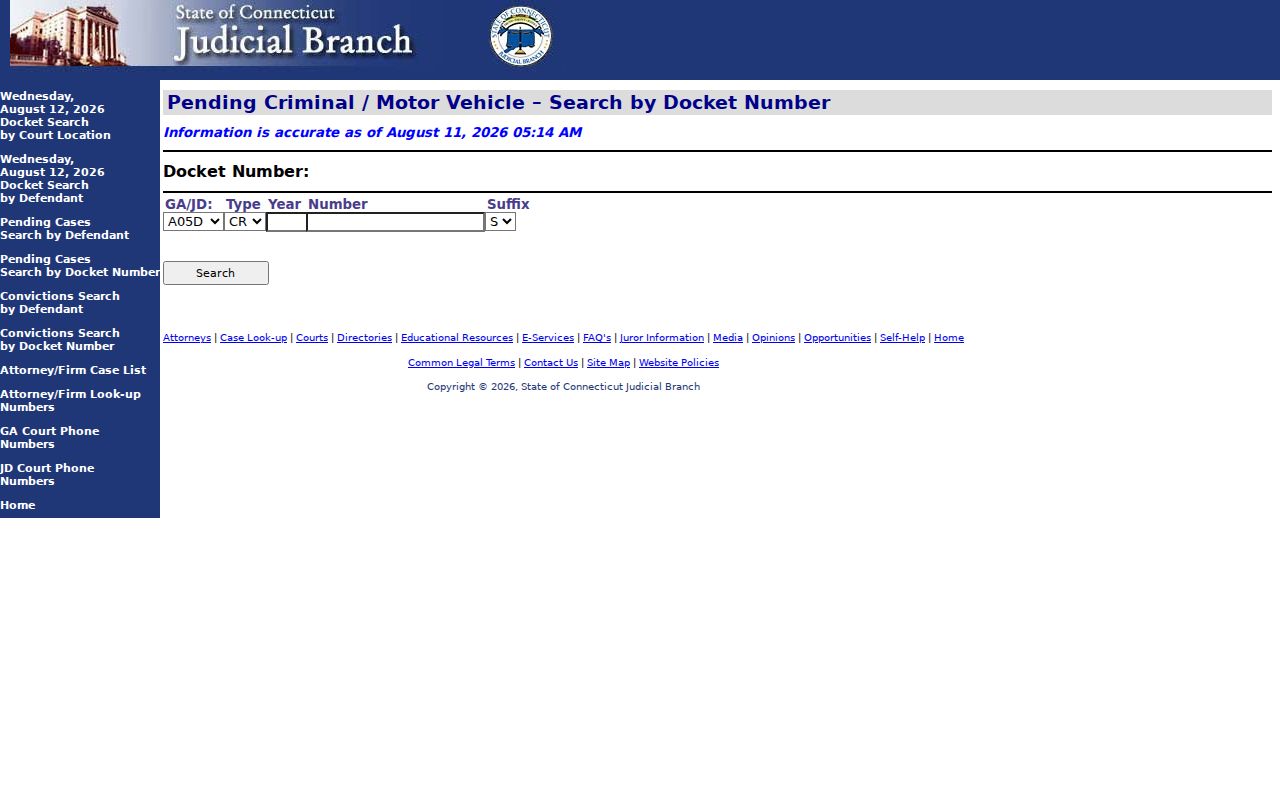
The form can identify a related case, but it does not promise a complete warrant-status response.
Connecticut Warrant Search Fields
Connecticut's pending-case tools provide the practical fields below. The docket is a lead for warrant research. It is not a statewide police warrant roster.
| Field Label | Type | Required | Notes |
|---|---|---|---|
| Last name begins with | Text | For name search | Prefix search with a maximum field length. |
| First initial and birth year | Text | No | Narrows common names; birth-year range may expand results. |
| Court location and case type | Dropdown | No | Filter to Criminal, Motor Vehicle, or a listed referral type. |
| Docket parts | Dropdown and text | For docket search | Court code, type, two-digit year, number, and suffix. |
What Connecticut Warrant Records Show
Details can be split between a docket, a public warrant paper, Bail Services, and the executing agency. Some fields may be sealed, withheld, stale, or unavailable online.
| Field | What It Shows |
|---|---|
| Defendant and docket | Identifies the related public case and court location. |
| Warrant type | May state arrest, bench, failure to appear, search, or violation-related process. |
| Underlying charge | Shows the public case allegation, which is not proof of guilt. |
| Bond or release information | May be available from Bail Services or the public case record. |
| Status | May be active, served, vacated, recalled, disposed, sealed, or not publicly confirmable. |
Connecticut Warrant Confirmation
Once the docket identifies a location, contact the courthouse chief clerk. Bail Services can answer permitted procedural and bond questions. Municipal police are the proper law-enforcement contact when that department sought or holds the warrant. A defense lawyer can communicate with the clerk and prosecutor and advise on surrender, bond, recall, or motion practice.
Representative numbers in the research include GA23 Chief Clerk at 203-789-7461 and Bail Services at 203-789-7482, plus GA7 Chief Clerk at 203-238-6130 and Bail Services at 203-238-6140. These are examples, not statewide hotlines. Verify the assigned court before calling.
For a different location, use the Judicial Branch courthouse directory or the local route in the project-area directory. Statewide conviction data from SBI answers a criminal-history question, not whether a judge has issued, recalled, sealed, or served a current warrant. Likewise, a DOC result confirms reported custody status rather than the current warrant status of a person who is not confined.
The Public Defender judicial-district directory illustrates location-based defense services.
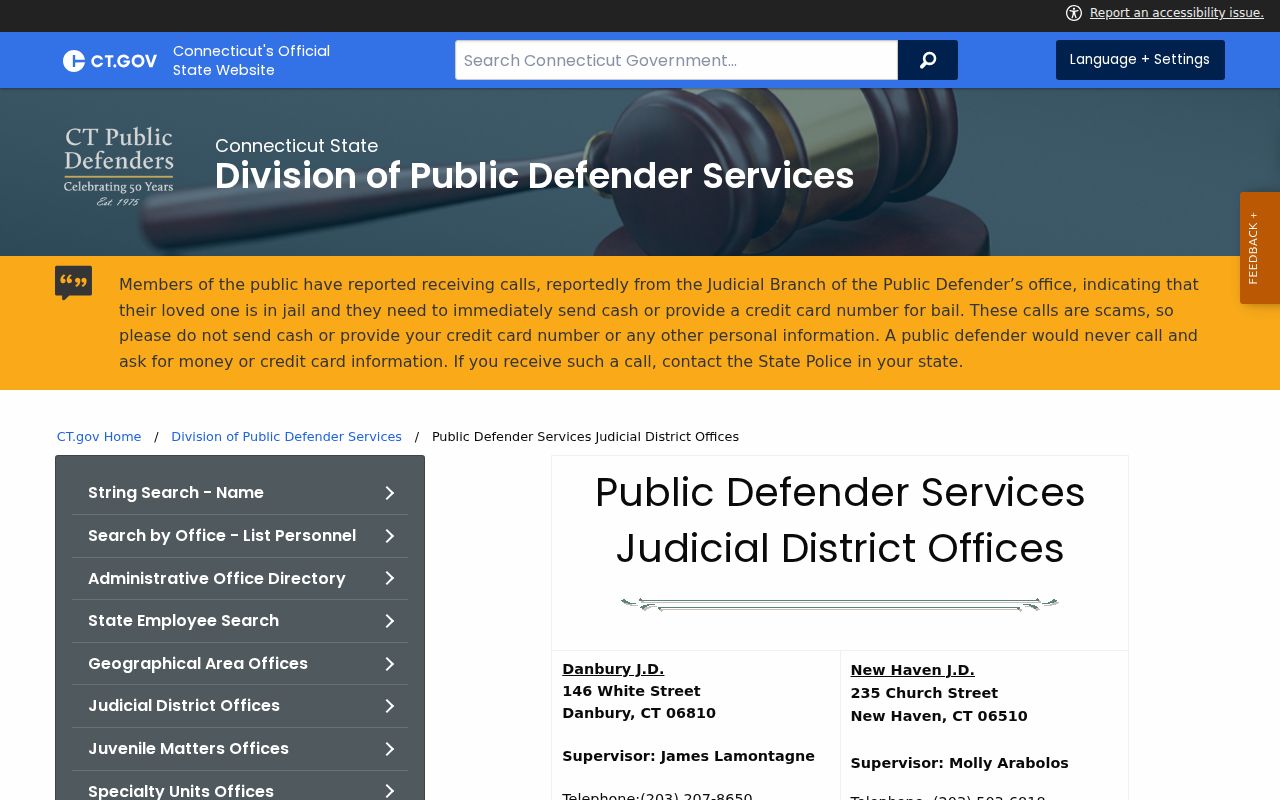
Eligibility and representation questions belong with the listed office, while warrant confirmation remains with the responsible court or agency.
Resolve a Connecticut Warrant
Do not ignore a suspected warrant or rely on silence from an online search. Identify the issuing court and case, then speak with a licensed Connecticut attorney about risk, bond, surrender, and any motion to recall or vacate. Bring identification, docket details, and proof of compliance or payment only when counsel or the court instructs you to appear. After resolution, check the docket again because public systems can lag.
Important: Consult a licensed Connecticut attorney before surrendering because an outstanding warrant can involve immediate arrest, bond, and incarceration.
The Geographical Area public-defender directory shows offices linked to Connecticut criminal venues.
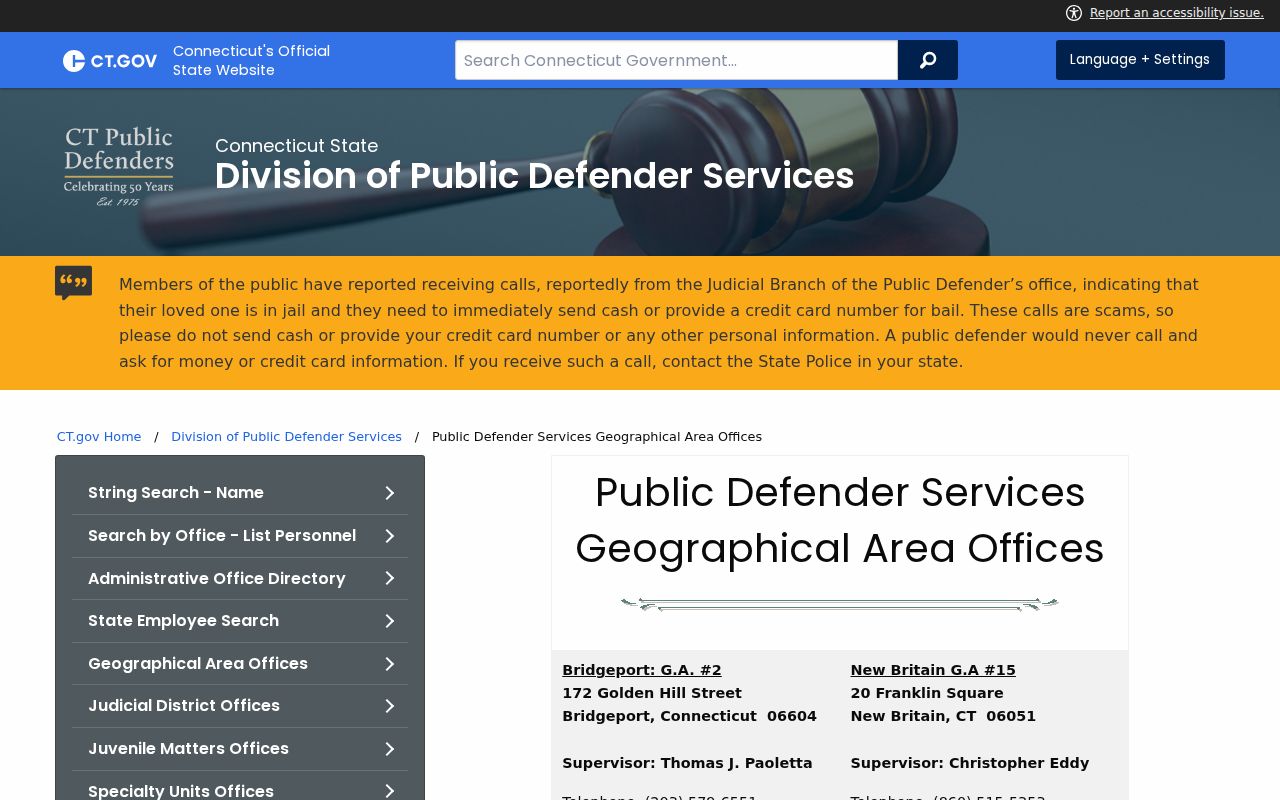
A directory is not a promise of representation, but it helps identify the office connected to the court location.
Connecticut Police and Tip Channels
No verified statewide Crime Stoppers warrant portal appears in the supplied research. Anonymous tip programs, when offered, are local police tools for sending information. They are not a safe way to ask whether the tipster has a warrant and do not replace the Judicial Branch, clerk, Bail Services, police records unit, or counsel.
When reporting information about another person, use the responsible municipal department's official channel and avoid confrontation. For emergencies, call emergency services. A tip submission may not produce a response or reveal whether an agency acted, and it should never be described as an official warrant confirmation.
Restricted Connecticut Warrant Records
Juvenile and youthful-offender matters are not ordinary public warrant records. Sealed warrants, erased cases, protected affidavits, and unexecuted search warrants can also be unavailable. A state criminal-history report is not a current warrant check, and the public sex-offender registry is not a warrant list. Federal warrants belong to the federal system and may not appear in a Connecticut Superior Court search.
The Judicial Branch news archive documented publication of the 2026 Connecticut Practice Book.
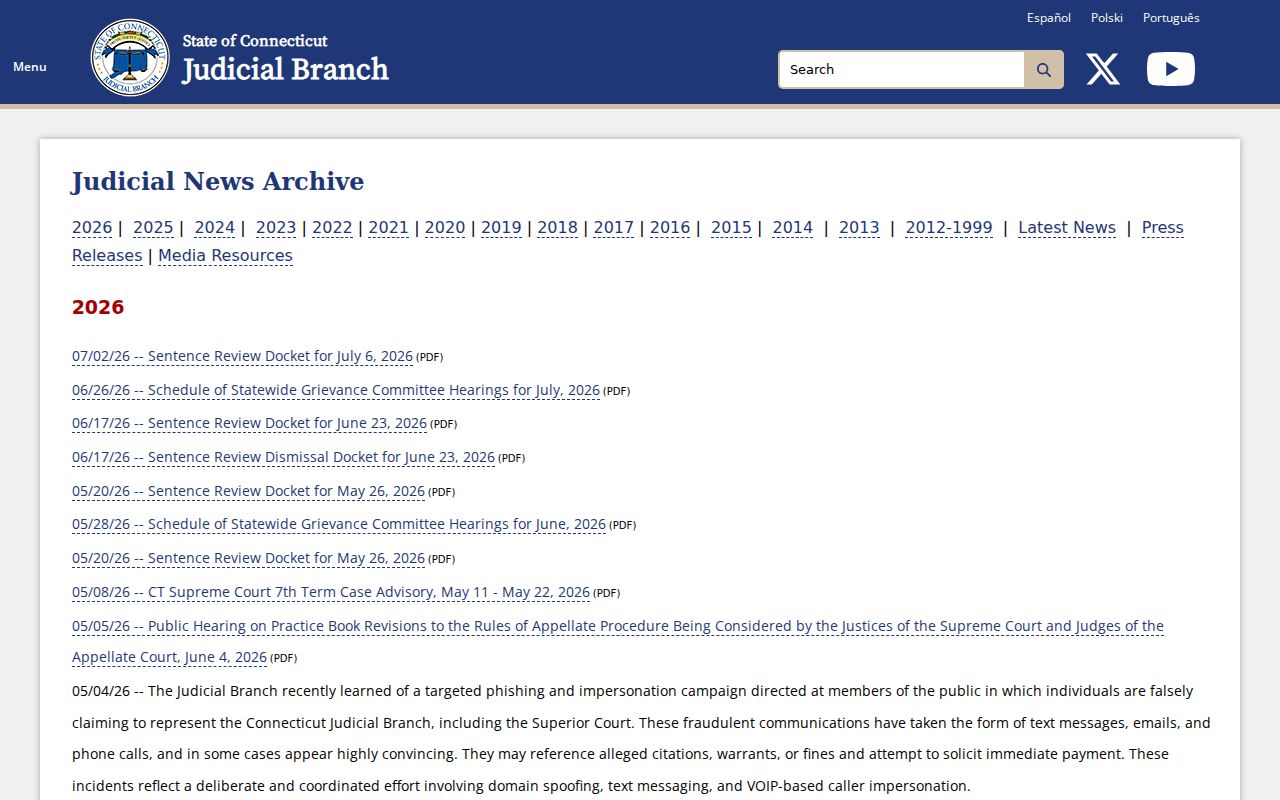
Practice Book rules govern procedure and some access questions, so the edition in effect on the request date matters.
Different warrant types also create different access questions. An arrest warrant authorizes an arrest based on a judicial finding of probable cause. A bench or failure-to-appear warrant arises from a court event, while a violation-of-probation warrant concerns claimed noncompliance with supervision. A search warrant authorizes a search and may remain sealed while execution or an investigation is pending. The public criminal docket can be a useful lead, but it may not display the warrant document, current service status, or protected affidavit.
When the name search returns no result, repeat it only with identifiers the official form accepts. Check both the pending defendant path and a known docket number. Next, identify the town tied to the event and its assigned Geographical Area or judicial-district court. The courthouse Chief Clerk can explain public docket access, Bail Services can address permitted bond procedure, and the municipal police agency can address a warrant it sought or holds. None of those channels should be replaced by a commercial people-search result.
After a court recalls, vacates, or serves a warrant, public systems may need time to reflect the change. Keep the court paperwork supplied at resolution and have counsel confirm the operative status when arrest or travel risk remains. A receipt for a payment, a new court date, or release from custody does not by itself prove that every related warrant entry has been cleared.
Note: A missing docket entry is not proof that no warrant exists; confirm through the responsible court, police agency, or counsel.